

the decade everything changed
The 1990s felt like the bridge between two worlds.
Wine bars began replacing traditional pubs, typesetting houses quietly disappeared, and computers started taking over from scalpels and spray mount. Almost overnight, the way we designed changed forever.
During this decade our studio grew to six people in Midlford Place, just off Tottenham Court Road, and every year seemed to bring another new piece of technology to learn.
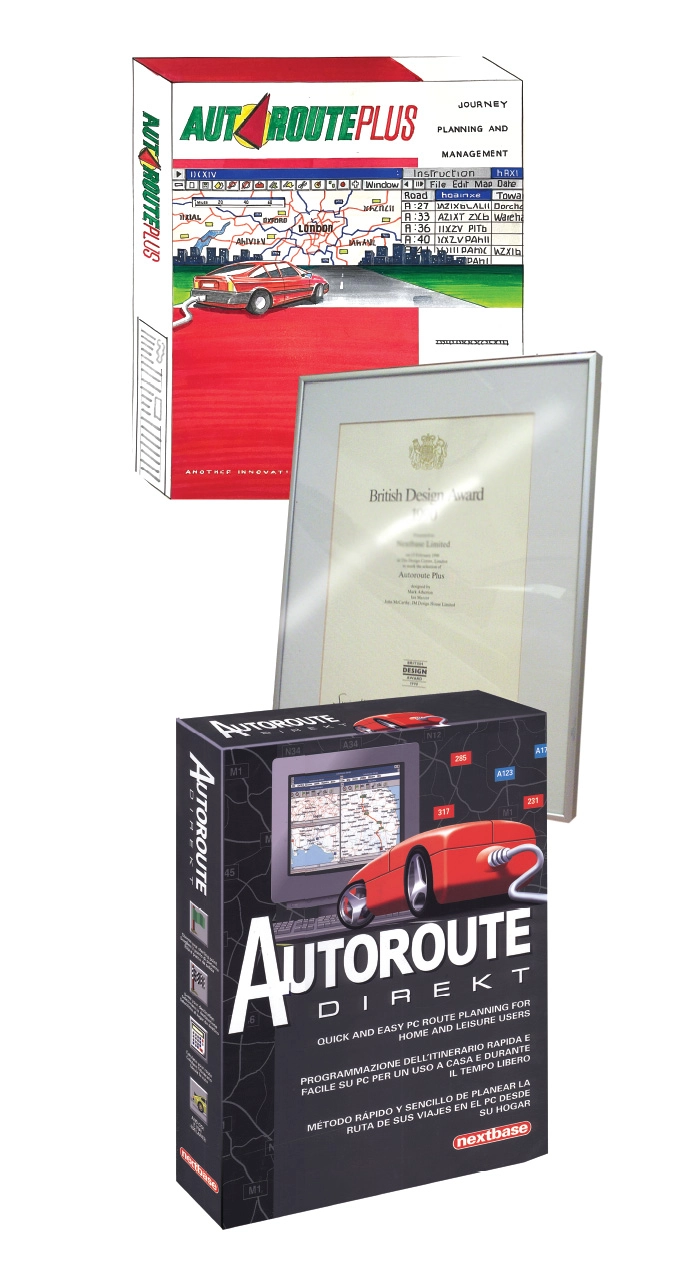
One project that always reminds me of this period was Nextbase.
At the time, it was a small technology company developing AutoRoute, one of the first consumer mapping programs. I remember working with the founders when the business was still based in a cottage in Wimbledon. Within seven years Microsoft acquired the company.
It’s satisfying to look back and know we played a small part in that journey.
The photographs on this page tell the story of the decade.
At the top is the original AutoRoute Plus packaging, presented as hand-rendered visuals using markers and felt-tip pens for a DOS-based product.
The centre image shows one of my proudest moments—receiving a British Design Council Award as part of the team behind the Nextbase identity.
The final image belongs to the end of the decade. Macs, Wacom tablets, and Rainbow Prints had replaced visuals, galleys, Chromalins and Letraset. Looking back now, the speed of change was extraordinary.
the mighty macintosh quadra
Digital design had arrived.
Our studio invested in an Apple Macintosh Quadra, complete with a huge 128MB of RAM, along with a Canon CLC10 colour printer and an Epson scanner. Boy, we thought it was the business.
The Quadra was so valuable that we had to have it chained it to the wall for insurance.
For the first time, we could typeset on demand. No waiting for galley proofs. No Chromalins. No rub-down lettering. Suddenly QuarkXPress, Aldus FreeHand and
Photoshop became everyday tools. It wasn’t always easy. Every new piece of software came with a learning curve, but there was a real sense that we were witnessing the future unfold.
For the first time, we could typeset on demand. No waiting for proofs. No Chromalins. No rub-down lettering. Suddenly QuarkXPress, Aldus FreeHand and Photoshop became everyday tools. It wasn’t always easy. Every new piece of software came with a big learning curve, (thank you Mike Hammond) but there was a real sense that we were witnessing the future unfold.
Macs!
juniors and bosses
One of my favourite campaigns from the decade came from Julie Dingwall, a talented junior designer in our studio.
The brief was refreshingly simple. Design window displays for around 600 jewellery stores using nothing more than a photocopied window template.
No strategy presentation.
No consumer research. Just ideas.
Julie created a wonderfully quirky series of seasonal campaigns. Easter became “Baaargains!” featuring a sheep. Summer became “unbeelievable bargains”.
My Boss, Graham Fitzpatrick (genius and very nice man) penned another classic for Mother’s Day, “Value for Mummy”. Priceless!
These campaigns used to clear huge amounts of jewellery stock and even managed to sell a warehouse full of gold Manchester United signet rings.
During the decade, Creative Direction Partnership, where I became a director, where acquired by Haygarth Group, a part of the famous M&C Saatchi Village.
It opened the door to much larger projects and some remarkable clients, while still allowing us to do what we enjoyed most—solving creative problems.


The Haygarth Group
During the decade, Creative Direction Partnership-where John was a key contributor-was acquired by the Haygarth Group in Wimbledon, part of the M&C Saatchi Village. It marked a new phase of opportunity, bringing access to major clients and large-scale projects.
Highlights: The BBC
Working with clients such as HSBC, Tesco, Dixons, and Tropicana brought many creative challenges-but the BBC stood out as a personal favourite.


- BBC 75th Anniversary: John contributed to the celebratory CD-ROM pack-a major digital milestone.
- BBC Licence Fee Website: The second iteration of the BBC website, where John’s team helped bring the grid layout to life. On it: Steve Wright, Des Lynam, and the Teletubbies-part of a record-breaking month with over 1 million hits.
- BBC Perfect Day: John worked on the website supporting the now-iconic “Perfect Day” video for Children in Need. Featuring artists like Bono, Elton John, Bowie, Suzanne Vega, and Joan Armatrading, the project felt like one where every late night and every ounce of effort truly mattered.
What’s not to like: Bono, Lesley Garrett, Robert Cray, Skye Edwards, Huey Morgan, Tammy White, David Bowie, Boyzone, Burning Spear, Thomas Allen, Suzanne Vega, Joan Armatrading, Heather Small, Elton John, Emmylou Harris, Ian Brodie, Bret Anderson, Shane McGowan. The song was released for Children In Need. Working for the BBC felt like every design challenge, late night (and there were many), and effort was truly worthwhile because it was genuinely appreciated.
“Thank you, BBC-it was a privilege.”
understanding teenagers
One pitch I’ll never forget took place at Barclays’ headquarters in Coventry.
As we waited to present, another agency walked into reception. One of their designers joked, “When was the last time we lost a pitch?” It could have been intimidating, but instead it made me even more determined. I’d spent time interviewing teenagers before the presentation, trying to understand how they viewed banks rather than making assumptions.
We discovered that teenagers liked being treated slightly older than they really were. That simple observation inspired a campaign built around age certification symbols set one year above the teenage recipient’s actual age, tying in with a cinema promotion offering free tickets.
We also knew If someone opened their first bank account as a teenager, there was 705 chance they’d stay with that bank for life.
The campaign went on to become one of Barclays’ most successful youth marketing initiatives. One of the photographs shows my daughter, who was five years old at the time, modelling for the Junior Barclay Plus campaign. She’s thirty now.
other projects along the way
The decade also brought opportunities to work on a wonderfully varied mix of projects, including point-of-sale campaigns for H. Samuel, retail promotions for Norton AntiVirus, packaging for CompuServe in the early days of consumer internet access, and promotional work for Symantec. One of the joys of those years was never knowing what the next brief would be.


Clients 🙂 H. Samuel Star Buys point of sale, Norton AntiVirus promotion, Compuserve software packaging (wow, an early web browser in the days of the internet!) and Symantec sales promotion with Animal.

ISDN…
the future (apparently)
Towards the end of the decade we installed an ISDN line so we could send artwork electronically from Wimbledon to the print bureaux in London’s West End.
In theory it was revolutionary.
In practice it was painfully slow.
The joke around the studio was that someone could probably walk the artwork across London faster.
I still remember one copywriter trying to reassure a frustrated client after yet another failed transmission.
“Well, if it’s right
up my end –
it’s definately
right up yours”
The entire studio dissolved into laughter.
Some files were simply too large to send anyway. If they wouldn’t fit onto a SyQuest cartridge or Magneto Optical disk, we had a wonderfully low-tech solution.
Unplug the Mac and climb into a taxi with it!
Not long afterwards, brick-sized mobile phones appeared. We’d barely mastered texting by repeatedly pressing number keys before email arrived and changed everything all over again.
Looking back, the pace of change throughout the 1990s was astonishing. At the time, though, it simply felt like another
Monday.